
Most advisory firms have an email list they barely use. Maybe they send a newsletter once a quarter, a few clients open it, and then… nothing.
Meanwhile, your clients are hearing from their bank, brokerage app, and robo-advisors every week. If you don’t stay in touch, someone else can easily become the voice they trust when it comes to their money.
That’s where email marketing comes in. You don’t need a big marketing team to get started, either. In this guide, I’ll cover what email marketing looks like for financial advisors, a few real examples, a six-step process for getting started, how to avoid the spam folder, and which tools are worth looking at.
What is email marketing for financial advisors?
Email marketing for financial advisors means sending planned, permission-based emails to clients and prospects to build trust, share useful financial guidance, and ultimately get more people into advisory conversations.
In practice, that usually means five types of email:
- Newsletters: A monthly email with one useful idea, such as how a rate cut could affect mortgage refinancing.
- Market commentary: A short, calm explanation of what’s happening when, say, markets drop 5% in a week.
- Nurture sequences: Automated emails that follow a lead magnet download or webinar signup.
- Client lifecycle emails: Onboarding emails, annual review reminders, and messages around birthdays or retirement milestones.
- Event invitations: Emails promoting webinars, seminars, and client appreciation events.
There are two big differences between this and email marketing for, say, a clothing store.
First, the sales cycle is much longer. Nobody is handing over their retirement savings because you offered them a 20% discount. People usually spend months evaluating an advisor, so your emails need to educate first and sell second.
Second, financial advisor emails come with more compliance requirements. In the US, the SEC marketing rule places restrictions on things like testimonials, endorsements, third-party ratings, and performance claims in adviser advertising unless certain conditions are met. A mass email to prospects can count as advertising.
So a line like “our clients beat the market last year” can create a compliance problem, while an online store could probably make a similar claim without the same regulatory concerns.
3 examples of successful email marketing campaigns for financial institutions
The best financial emails usually have one clear job. Here are three examples from large financial institutions, plus what a smaller advisory firm can take from each one.
You can also browse hundreds more examples in the Really Good Emails finance gallery.
1. The Vista Group at Morgan Stanley: the advisor newsletter
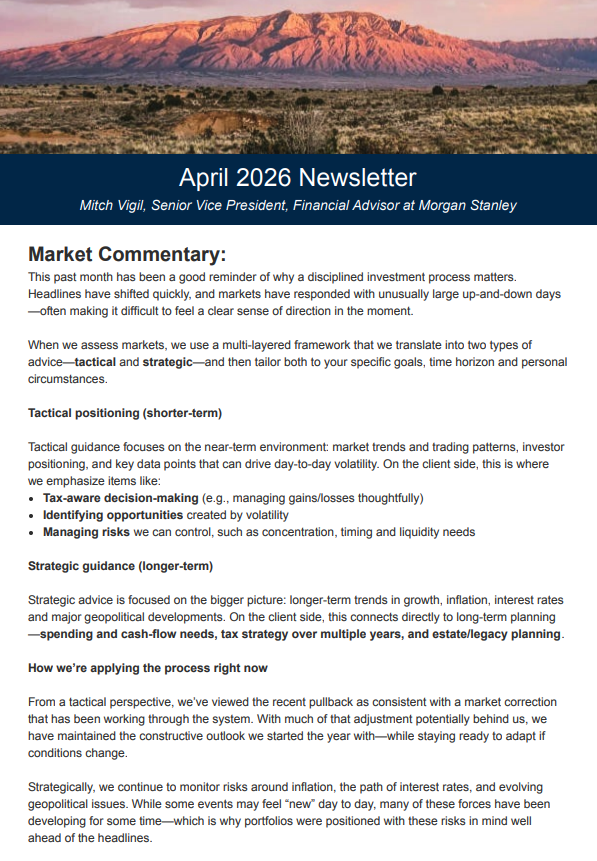
This newsletter works because it feels like it came from a person, not a bank. The market commentary explains the team’s process instead of predicting returns, a short family update makes the advisor human, and a gentle referral ask closes it out. Ready-made articles from the firm fill the rest, so it’s cheap to produce.
For advisors, that matters because clients don’t hire a firm, they hire you, and every personal note reminds them who’s looking after their money. When a client’s friend mentions market worries, that client already knows you’re happy to help, because your last email told them so.
2. Swedbank: the seasonal “financial health” newsletter
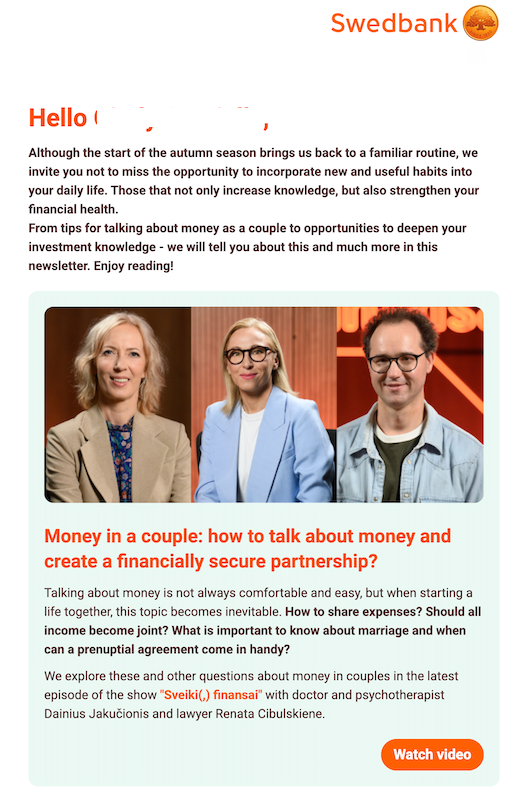
This newsletter works because it talks about the reader’s life, not the bank’s products. An autumn “new habits” hook makes it feel timely, and topics like money in a couple and scam protection earn attention for the investment content. Each block has one color and one button, so it’s easy to skim.
For advisors, a client who learns from you how to spot a scam, or how to talk about money with a partner, sees you as their go-to for every money question, not just their portfolio. And when a fraudster impersonates your firm, clients who’ve read your safety tips are far more likely to call you before they click.
3. Wise: the “you’re almost done” nudge
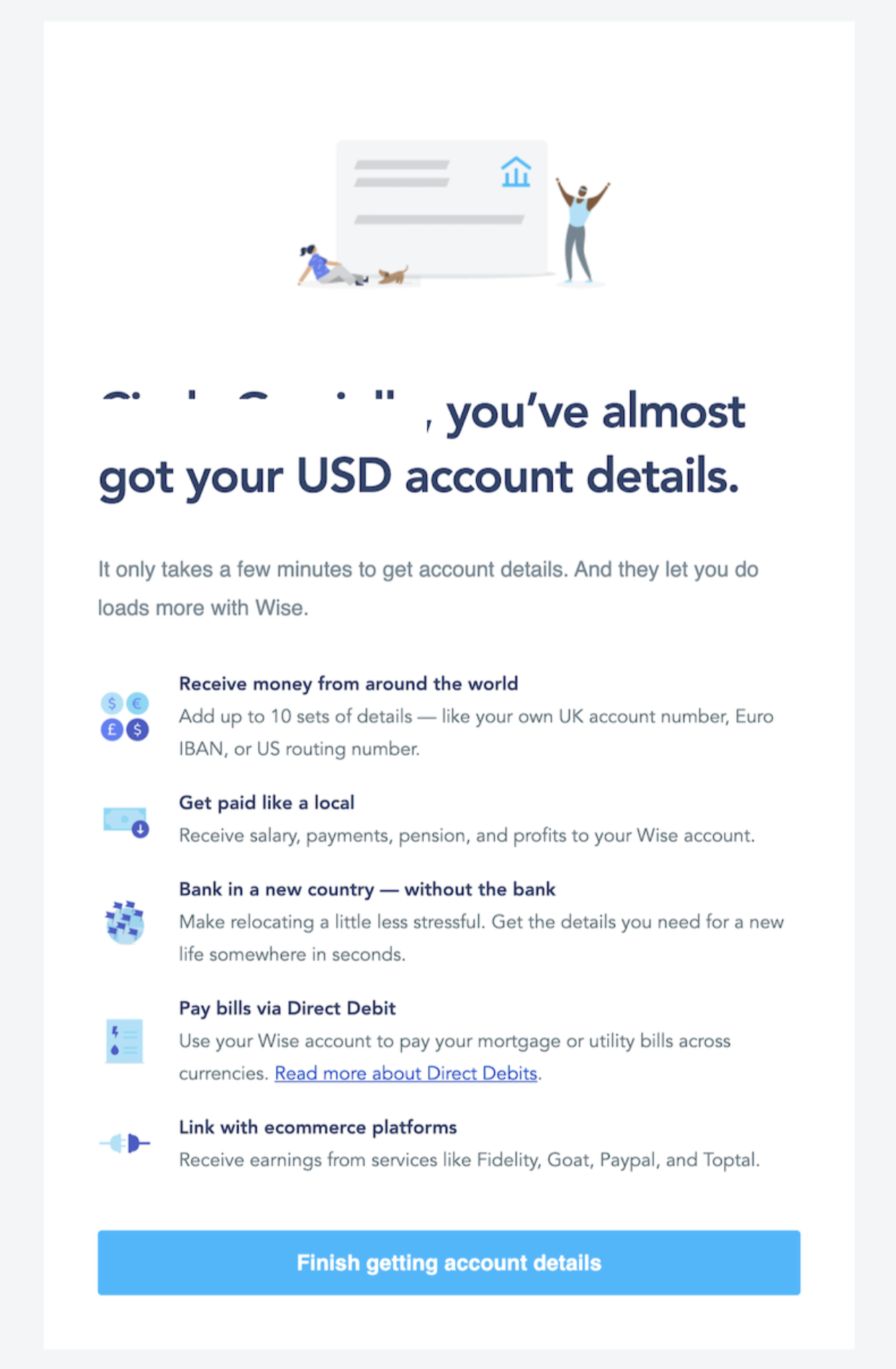
This email works because it removes every reason not to finish. It arrives while intent is still fresh, makes the task feel small, shows what you’ll get in five quick benefits, and gives you only one button to click.
For advisors, prospects stall at the same point, halfway through a long intake form or a document upload. A short, friendly reminder sent within a day catches them while they’re still interested, and it does the follow-up you’d otherwise forget to make.
Does email marketing work for financial advisors?
Yes. Email can work well for financial advisors because people tend to engage with financial emails, and the cost of running the channel is relatively low.
The bigger issue is what happens after someone opens the email.
According to Brevo’s email marketing benchmarks, financial emails get opened slightly more often and have a lower unsubscribe rate. But people click on them less.
That usually suggests the trust is there, but the content isn’t always giving readers a strong enough reason to take the next step.
But there’s one possible solution: automation. Triggered emails based on something a reader actually did average a 30.63% open rate and a 7.39% click-through rate. That’s more than three times the click rate of standard campaigns.
You also don’t need a huge list for this to be useful. Say you have 300 subscribers and get a 1.87% click rate. That’s roughly five or six clicks per email. If even one of those clicks eventually turns into a client, the economics can look pretty good.
There are three objections I hear most often.
“Compliance makes it too risky.”
Compliance can slow things down, but it doesn’t mean you can’t email clients and prospects. Educational content without performance claims or testimonials is generally easier to review, and having pre-approved templates can make future campaigns much faster.
“I don’t have time.”
You don’t need to send three emails a week. One useful 200-word email a month plus a simple welcome sequence is a good starting point. Once they’re set up, there’s not much ongoing work.
“Open rates aren’t reliable anymore.”
That’s true. Apple Mail Privacy Protection can preload emails and inflate open rates. Brevo, for example, reports a second finance figure of 32.38% when Apple opens are included.
So don’t obsess over opens. Pay more attention to replies, clicks, and booked meetings.
Email tends to go wrong in two situations: when you buy a list and when you make promises about returns. The first can hurt your sender reputation, while the second can create a compliance problem.
What is the best way to start email marketing for financial advisors?
Step 1. Define your goals and strategy
Start with one measurable goal for the next 90 days.
“Stay top of mind” sounds nice, but you can’t really tell whether you achieved it.
Instead, try something like “book six discovery calls from the newsletter this quarter” or “get 80% of clients to schedule their annual review by email.” If your firm already plans in 90-day priorities, make this goal one of them so it gets reviewed every week.
Then create a one-page email marketing strategy that answers four basic questions:
- Who are you emailing?
- How often will you email them?
- Who needs to approve each email?
- Which number will you use to measure success?
For most firms, start with one email a month. A schedule you can actually stick to is much better than a weekly plan you abandon three months later.
Step 2. Segment your audience
Segment your list before you start writing. The more relevant the email is, the more likely people are to click.
For example, an email about Roth conversions could be useful to a 58-year-old client but completely irrelevant to a 30-year-old.
At the very least, separate clients from prospects. From there, you can add a few segments based on life stage:
- Pre-retirees (55 to 65): Social Security timing, withdrawal strategies, Medicare deadlines.
- Young professionals: Equity compensation, buying a first home, 401(k) matching.
- Business owners: Entity structure, exit planning, and tax exposure.
Segmentation also lets you send more specific content than a general email blast ever could.
Step 3. Collect contacts and grow your email list
Only add people who have actually asked to hear from you.
Buying a list might seem like a quick way to grow, but it can lead to spam complaints and hurt your sender reputation. It can also affect emails you’re sending to existing clients.
For advisors, four sources can work particularly well:
- A lead magnet on your site: For example, a one-page “Am I on track to retire at 62?” checklist in exchange for an email address.
- Webinar and seminar signups: Add an opt-in checkbox to your registration form.
One important distinction here: cold outreach and your newsletter aren’t the same thing.
Keep cold emails separate, and only move someone onto your marketing list after they’ve explicitly opted in.
Step 4. Create useful and personalized content
When planning a newsletter, start each email with a real question you’ve heard from a client.
You don’t need to personalize every email with someone’s first name, either. Segment-based personalization, such as “for clients within five years of retirement,” can be much more useful.
A simple structure is enough:
- The question.
- Your answer in two or three short paragraphs.
- One clear next step, such as booking a call.
I’d keep most emails under 250 words.
If you prefer talking to writing, video can make this easier. For example, you could record a ten-minute monthly market update, which can transcribe the recording and create short AI-generated clips. Use one of those clips in the email and turn the transcript into your draft.
Before sending anything, run through this checklist:
- No performance promises. “We aim to reduce sequence-of-returns risk” is very different from “we’ll beat the S&P.”
- No testimonials unless you’ve included the required disclosures.
- Your firm’s disclosure footer, physical address, and working unsubscribe link.
- Compliance approval and an archived copy of the email you sent.
- No account numbers, statements, or other sensitive client data in the body. Larger firms enforce this automatically with tools that scan outgoing email for exactly that.
Step 5. Set up automated email sequences
Automate the emails that should go out after a specific action.
Triggered emails can get significantly more engagement than one-off campaigns, and you only have to write them once.
I’d start with a welcome sequence for new subscribers:
Day 0: Deliver the checklist they signed up for.
Day 3: Explain the most common mistake you see around that topic.
Day 7: Walk through how your planning process works.
Day 14: Answer the fee question directly.
Day 21: Invite them to a 20-minute introductory call.
After that, you can add things like an annual review reminder for clients and a follow-up email an hour after every first meeting. After a first meeting, an AI note taker can capture the client’s questions and agree on next steps, giving the follow-up email useful context before it goes through the firm’s compliance review.
Step 6. Test and optimize your campaigns
Always test an email before it goes out. After that, change one thing at a time so you know what’s actually making a difference.
A broken link in an email about someone’s retirement account can cost you much more trust than a typo in a retail promotion.
For pre-send testing, you can use a sandbox. Mailtrap’s Email Sandbox catches test emails, checks how the HTML works across different mail clients, and gives you a spam score before the email reaches a real client.
After sending, don’t read too much into small A/B tests. If you have 300 subscribers, a subject-line test isn’t going to tell you much.
Instead, compare results over several campaigns or quarters.
I’d focus on three numbers:
- Replies
- Meetings booked
- Unsubscribe rate
If your unsubscribe rate consistently gets above 0.5%, it’s worth looking at your targeting and sending frequency.
How to improve email deliverability for financial advisors
Good email deliverability comes down to a few basics: authenticate your domain, only email people who opted in, and keep spam complaints low.
In simple terms, deliverability is about whether your emails actually reach the inbox instead of ending up in spam or getting blocked.
For advisors, this matters even more because your newsletter and one-to-one client emails often use the same domain. A poorly managed campaign can potentially affect important client communications, too.
And getting into the inbox isn’t guaranteed. Validity’s 2026 benchmark, as reported in the same Brevo benchmark, found that 87.2% of emails reached the inbox globally in 2025, United States 86.8%. Inbox placement varied by provider, reaching 89.8% at Gmail and 77.4% at Microsoft.
These five habits cover most of the basics:
- Authenticate your domain with SPF, DKIM, and DMARC. These DNS records help email providers verify that your emails really came from your firm. Gmail and Yahoo require authentication for bulk senders, and financial services are a common phishing target.
- Send from your own domain. Use something like jane@oakridgewealth.com rather than a free Gmail or Outlook address.
- Keep spam complaints under 0.1%. Gmail’s hard limit for bulk senders is 0.3%. On a 300-person list, a single complaint is already about 0.33%, so even one complaint can matter.
- Remove inactive contacts. If someone hasn’t engaged with your emails for six months, send a simple “still want these?” email and stop emailing them if they don’t respond.
- Separate your email streams. Keep newsletters, client service emails, and cold outreach on separate subdomains or domains where appropriate. That way, a problem with one stream is less likely to affect the others.
Also include a one-click unsubscribe link in every marketing email. Giving people an easy way out is much better than having them mark your email as spam.
What is the best email marketing service for financial advisors?
Look for an email marketing platform that can help you get into the inbox, automate sequences without a lot of technical work, and keep a record of what you’ve sent.
For most independent advisors, look at Mailtrap.
The reason is pretty simple: advisors typically send relatively low volumes of high-stakes emails. Deliverability matters more than having hundreds of fancy templates.
Here’s how Mailtrap lines up with the main things an advisory firm needs:
| What you need | Why it matters to an advisor | What Mailtrap offers |
| Deliverability | Client emails shouldn’t end up in spam | Separate streams for transactional and bulk email, plus SPF, DKIM, and DMARC setup |
| Automation | Welcome and review sequences shouldn’t require manual work | A visual, no-code Automations builder included in every plan |
| Segmentation | Retirees and founders need different emails | Segments and custom contact fields |
| Security | You’re dealing with sensitive client information | GDPR compliance, SOC 2, and ISO 27001 |
| Testing | Small mistakes can cost trust | Email Sandbox for pre-send checks |
| Price | Small lists shouldn’t be expensive | Free plan; paid plans start at $15 a month |
The $15 Essential plan covers 30,000 emails a month to 10,000 contacts, which is plenty of room for a typical advisory practice.
There are two things to keep in mind, though.
First, Mailtrap is a general email platform. It doesn’t come with a library of pre-approved financial content, so you’ll still need to write your own emails and send them through your firm’s compliance process.
Second, your broker-dealer may already require you to use a specific platform or archiving provider. If that’s the case, follow that requirement and check with your compliance officer before signing up for anything new.
Otherwise, you can start with the free plan, authenticate your domain, and build the welcome sequence from Step 5 before you send your first newsletter.
What’s next?
Start with one segment and write one useful email this week. That’s really it.
The whole process comes down to a pretty simple loop: choose a goal, send something useful to people who asked to hear from you, and see whether they respond.
Compliance and deliverability are the guardrails that keep that process running smoothly.
One more thing, reply to people who respond to your emails personally. A newsletter can get someone’s attention, but a two-line personal reply is often what starts an actual conversation.
If you’re completely new to email marketing, Mailtrap’s email marketing guide for beginners covers the basics. Then come back to Step 1 and set your 90-day goal.