Skip to Navigation


Renewal season is around the corner, but half the reminders you send still get ignored. Sound familiar?
Here’s the problem. Insurance is a product people think about once a year, and most agents show up in the inbox during that exact same week. One notice. One shot. Then eleven months of silence.
Email marketing for insurance agents fixes the silence. It turns a scattered mix of reminders and cold pitches into a system that keeps policyholders engaged between renewals.
This guide covers what that looks like in practice: real examples, the types of emails worth sending, the software, and a four-step framework you can start using this week.
What is email marketing for insurance agents?
Email marketing for insurance agents is the practice of using targeted email marketing campaigns to reach prospects, retain existing policyholders, and stay visible across the long stretches between real purchase decisions.
Insurance is low-frequency and high-trust. Most clients only think about coverage at renewal, or after something goes wrong. That gap is where email earns its keep.
If you’re new to the channel entirely, the fundamentals of email marketing carry over here without much translation. What changes is the calendar you hang them on.
Unlike a general newsletter, insurance email campaigns center on a handful of recurring moments: renewals, coverage gap reminders, a new product launch, and life-event triggers like a home purchase or a growing family.
Each of those carries a natural reason to reach out, which makes the insurance industry one of the easier verticals to build an email calendar around. The triggers write themselves.
But does the approach change depending on who you are? Somewhat. Independent insurance agents work a smaller book and can personalize heavily. Commercial insurance agents deal with longer cycles and more stakeholders per account. Email marketing for insurance brokers leans harder on market updates and comparison, since a broker’s whole value is breadth.
The mechanics stay the same, yet the content shifts.
3 examples of successful email marketing campaigns for insurance agents
1. The renewal reminder sequence
One email seven days before a renewal gives a client no room to ask questions. Split it into three.
Sixty days out, flag that the renewal is coming and offer a review. Thirty days out, surface anything that has changed in their situation. Seven days out, confirm.
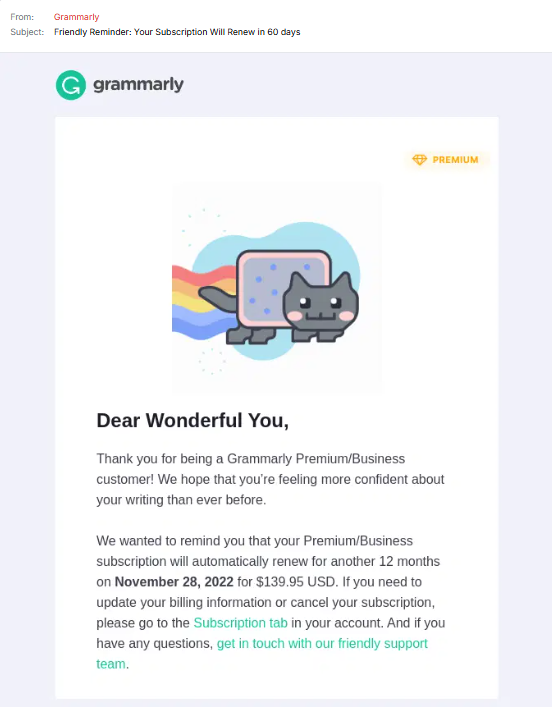
Grammarly’s version is the first email of that structure done properly. The renewal date and the exact amount sit at the top, so nothing about the charge is a surprise later. Below that, a reminder of what the subscription covers and a comparison against the free plan.
Swap “premium features” for “your coverage,” and it’s the sixty-day insurance email almost line for line: here’s the date, here’s the number, here’s what you’d lose. Sending it early gives the client time to ask a question rather than react to a charge.
The sequence also spreads renewal questions across several weeks instead of dumping them on your staff in the final seventy-two hours.
2. The life-event trigger email
A client updates their address in the CRM. That fires an email asking whether their home coverage still fits.
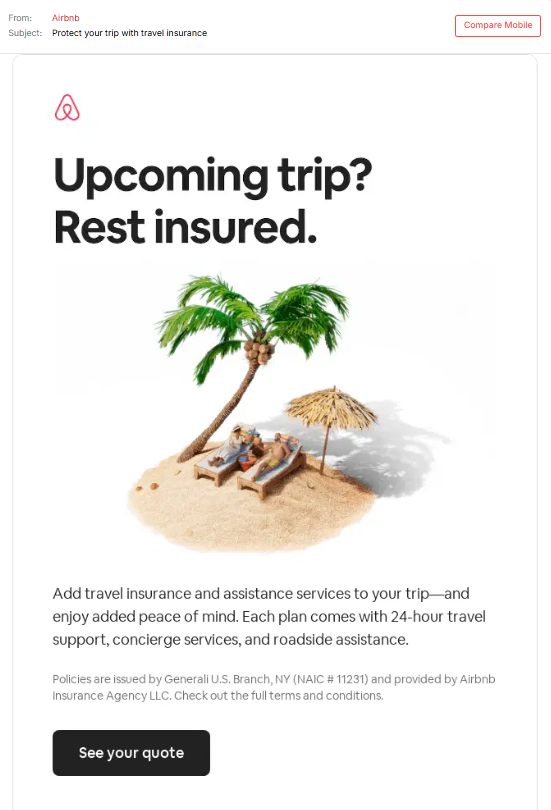
Airbnb isn’t an insurer, which is exactly why this one is worth studying. The email only makes sense because the recipient just booked a trip. That single event is what turns a coverage pitch into a useful reminder instead of a cold offer.
Your triggers work the same way. A new address, a new vehicle, a marriage, a first child. The client already has the subject in their head, so the email reads as timing rather than targeting.
Timing is the whole trick. Someone who just moved already has insurance somewhere in their head, so the message reads as useful rather than random.
3. The educational drip campaign
New policyholders are confused, and confusion generates support tickets.
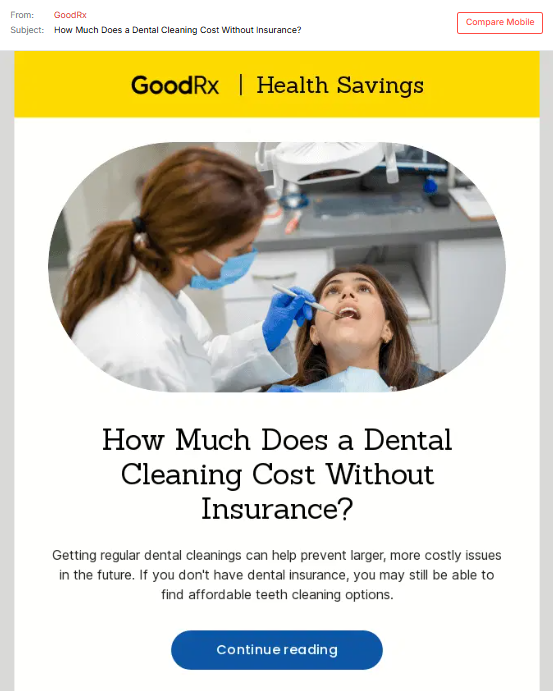
Notice what this email does not do. It doesn’t pitch a plan or push a renewal. It takes one question a policyholder is already Googling and answers it properly.
That’s the whole shape of an educational sequence. One topic per email, each one closing a question that would otherwise arrive as a phone call. The claims process. Coverage limits. How to update a policy.
A short onboarding series covering those handles most of the confusion. Spread it across three weeks. Don’t send it as one wall of text on day one.
Fewer avoidable calls. More time for the conversations that actually need a person.
What types of emails should insurance agents send?
Most agents send two types of emails and wonder why the email list goes cold.
There are nine worth building: welcome emails, transactional emails, a renewal sequence, a monthly newsletter, quote follow-ups, birthday and policy anniversary emails, enrollment reminders, cross-sell and upsell emails, and seasonal risk alerts.
Here’s when each one fires and what it’s for.
| Type of email | When it sends | What it’s for |
| Welcome emails | Immediately after a new client signs | Sets expectations, confirms contact information, tells them who to call |
| Transactional | Triggered by an action | Policy documents, payment confirmations, claim status updates |
| Renewal sequence | 60, 30, and 7 days out | Retention |
| Email newsletter | Monthly | Keeps you top of mind, builds brand awareness |
| Follow-up email | 2 to 3 days after a quote | Recovers stalled quotes before they go cold |
| Birthdays and policy anniversaries | Annual | Goodwill and a natural opening for a review |
| Enrollment reminders | Ahead of an open enrollment window | Drives action against a real deadline |
| Cross-sell and upsell | After a positive interaction | Turns existing clients into multi-policy clients |
| Seasonal risk alert | Ahead of storm, wildfire, or winter season | Delivers value before it asks for anything |
Transactional email deserves a note. Open rates on it run far above anything you’ll get from a campaign, because people are waiting for it.
Resist the urge to stuff a pitch in. A payment receipt with a sales banner bolted on is how you train clients to ignore your receipts.
What are the benefits of email marketing for insurance agents?
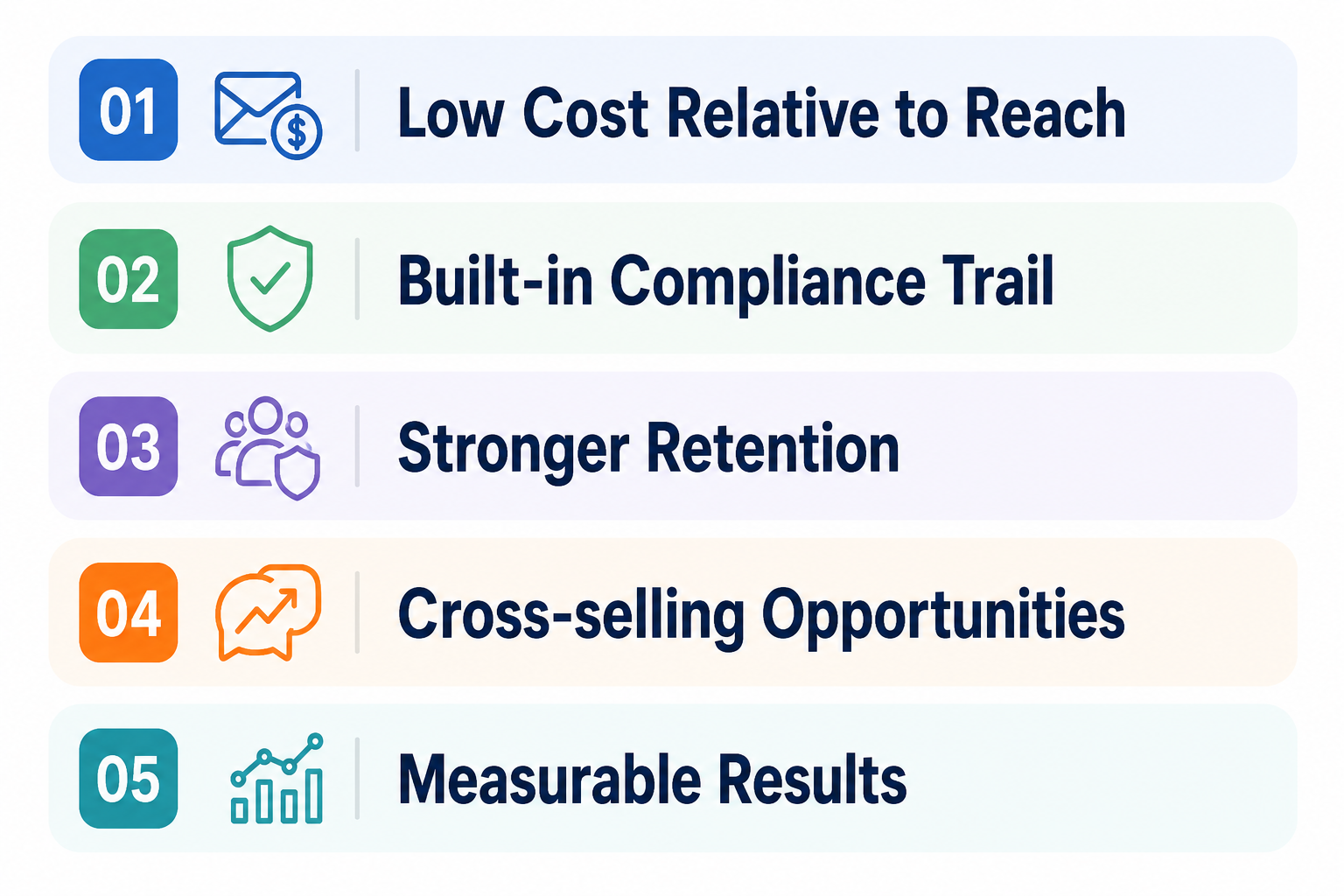
The benefits of email marketing for insurance agents show up in the gaps between transactions, not in the transaction itself. Here’s what they are:
Low cost relative to reach: One send reaches your entire book for a fraction of what direct mail or a round of cold calls costs. For a small insurance business on a tight budget, no other marketing channel comes close.
A compliance trail by default: Email creates a documented record of what went out and when. In an industry where a disclosure sometimes has to be proven months later, that matters more than it sounds.
Stronger retention: Useful contact between renewals keeps you top of mind and cuts the odds that a client shops around out of simple unfamiliarity with what they already have.
Cross-selling and upsell: A client with auto coverage who has never heard about umbrella or renters policies is lost revenue sitting in your own database. One email recovers it without a sales call.
Lead generation: A gated coverage checklist or a comparison guide collects contact information from potential customers who aren’t ready to buy yet, which is most of them.
Measurable return on investment: Open rate, click-through rates, conversion rates, and renewal outcomes all trace back to a specific send. Insurance sales stops being a guess.
Worth saying what email does not do. It won’t close a complex commercial account, and it won’t replace the phone call after a total loss. It handles the predictable, scheduled side of the customer relationship so your team can spend its hours on the rest.
How to do email marketing for insurance?
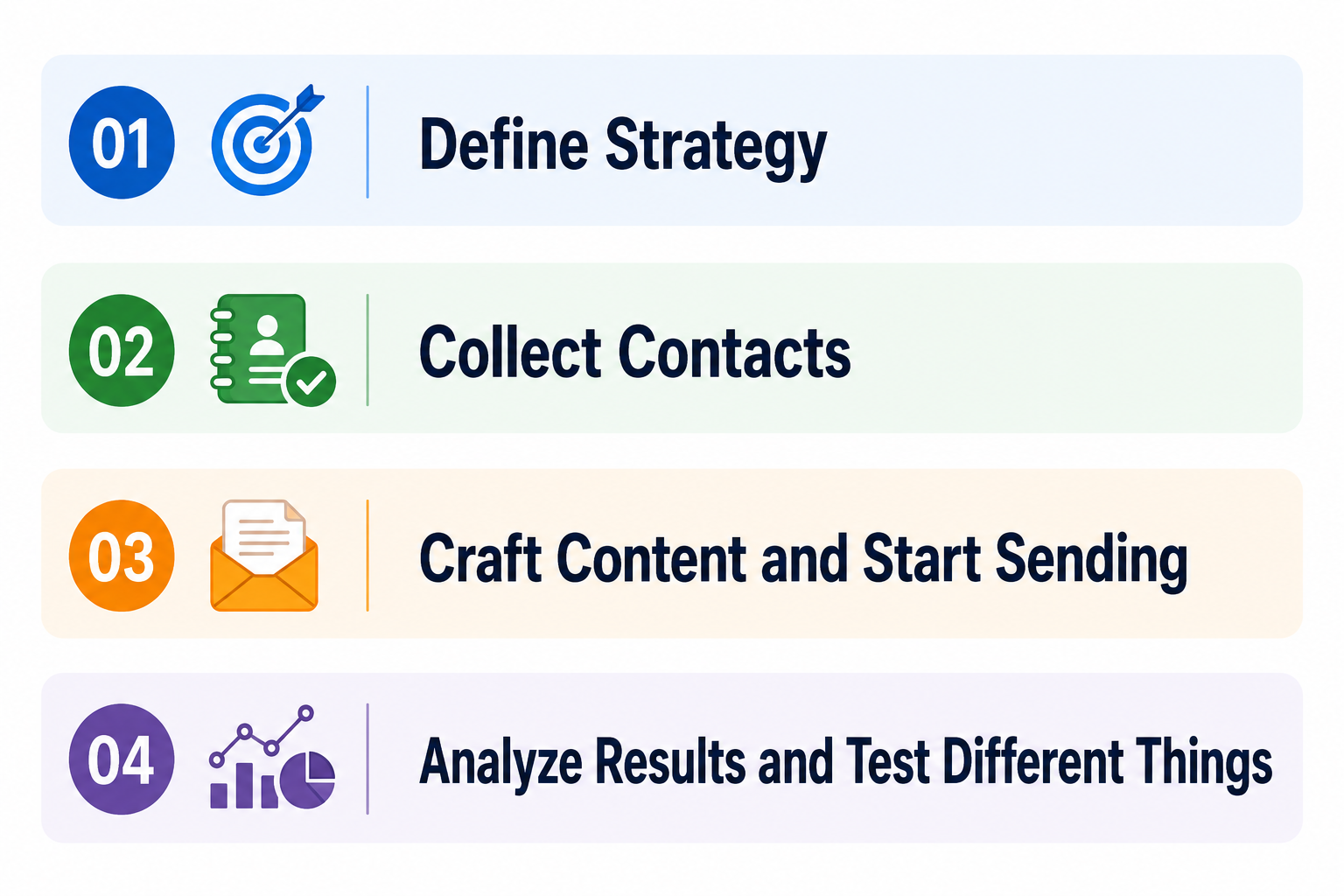
Good email marketing for insurance comes down to a repeatable framework, not one clever campaign. Instead, it’s four stages, following a particular order.
Step 1. Define the strategy
A renewal reminder and a cross-sell email have different jobs. Treat them the same, and both underperform.
Pick two or three goals to start with: retention, cross-selling, and referrals. Then choose a marketing tool that supports the automation those goals actually need, not the one with the longest feature list.
Your email marketing strategy should also name a target audience per campaign. “All contacts” is not a segment.
Step 2. Collect contacts
A list built from your own book with proper opt-in beats a purchased list every time. Purchased lists also put your sender reputation at risk, which in insurance is a compliance headache, not just a deliverability one.
You already sit on a valuable email list: your existing policyholders. The work is keeping it usable.
Segment by policy type, renewal date, household composition, tenure, and lifecycle stage. Then scrub it. Remove hard bounces after every send. A list nobody has cleaned in two years will quietly wreck your deliverability, and you won’t notice until a renewal notice lands in spam.
Step 3. Craft content and start sending
Write email content that respects how little time anyone wants to spend thinking about insurance. One idea. One obvious next step.
The subject line carries more weight than the rest of the email combined. A few that work in this vertical:
- Your policy renews March 14 – quick review?
- You moved. Does your coverage know?
- Three things your auto policy probably doesn’t cover
- Claim filed? Here’s exactly what happens next
- Bundling could cut your premium – worth 10 minutes?
Notice what those have in common. Short, specific, and not one of them says “newsletter”.
Then schedule around known moments: renewal windows, seasonal risk periods, enrollment deadlines, life-event triggers. Not an arbitrary Tuesday.
One more thing gets missed constantly. Every email points somewhere, usually a landing page, a policy review form, or a scheduling link.
You can write a great subject line, earn the open, earn the click, and lose the entire thing on a page that takes six seconds to load on a phone. The email did its job. The destination didn’t.
So treat the destination page as part of the campaign. Test it the way you test a subject line. Load it on a phone, on a weak connection, and count the seconds. Then check what the page actually asks for. A “review my coverage” link should land on a review request, not a general homepage that makes the reader hunt.
Most agencies can’t fix this in-house. The website usually belongs to whoever built it two years ago, while email sits with someone else entirely, so nobody owns the handoff between them. Closing that gap takes either one owner across both, or a conversion-focused website design service that rebuilds the page around the single action the email is asking for.
Step 4. Analyze results and test
Track open rates, click rates, and renewal outcomes tied back to specific campaigns, including calls that started from an email link.
Track per campaign, not in aggregate. Aggregate metrics hide the campaign that’s failing.
| Metric | What it tells you | Rough range in insurance |
| Open rate | Whether the subject line and sender name worked | 44.4% |
| Click-through rate | Whether the offer matched the segment | 1.36% |
| Conversion rate | Whether the landing page held up | 3.19% |
| Unsubscribe rate | Whether you’re sending too often or off-topic | 0.27% |
| Renewal rate by segment | The only number that pays your bills | Your own trend line |
Benchmarks move around by state, line of business, and list age. Your own trend matters more than anyone’s published average.
Test one variable at a time. The subject line, the send time, or the 60/30/7 cadence itself.
What is the best email marketing software for insurance agents?
It depends on list size and how much automation you genuinely need.
| Email marketing software | Best for | Strengths | Watch out for |
| Mailchimp | Solo and small agents under 5,000 contacts | Strong email templates, easy segmentation, cheap to start | Automation tiers get expensive quickly |
| Constant Contact | Agencies handing sends to non-marketing staff | Simple editor, solid support, event tools | Thinner automation and branching logic |
| CRM-native marketing platform | Multi-line agencies | Renewal dates and policy data feed triggers directly, no re-entry | Real setup cost, needs an internal owner |
Whatever platform you choose, a few features matter more in insurance than elsewhere:
- Segmentation by policy type and renewal date: Without it, you can’t build the 60/30/7 sequence or target a cross-sell to the right book.
- Deliverability you can rely on: A time-sensitive renewal notice landing in spam is a retention problem, not just a marketing one.
- Record-keeping: Anything touching disclosures or coverage confirmations needs to be provable months later.
Sure, email handles the scheduled side of client communication, but insurance rarely stays scheduled.
A client opens your renewal reminder and immediately wants to know about their deductible. Someone reads the claims explainer at 9 PM and wants to know whether their situation qualifies. Your email did exactly what it was built to do, and now there’s nobody there to answer.
That’s the gap conversational AI for insurance like Murf fills. It can handle coverage questions and the first notice of loss round the clock rather than queuing a callback for Tuesday morning. The same system that answers a deductible question at 9 PM can walk someone through a claim: confirming who they are, capturing what happened, collecting photos and location in one pass, issuing a reference number, and then escalating anything that needs a person.
What makes it fit insurance rather than just any support queue is the record it leaves. Every interaction is logged and timestamped, which is the same compliance-trail argument that makes email worth keeping, applied to the phone. The routine questions get answered while the conversations that need judgment still reach a person, with a documented trail either way.
The point isn’t automation. It’s that interest cools fast, and an unanswered question at 9 PM turns into a renewal you have to chase in March.
5 email marketing ideas and templates for insurance agents
Build these once as reusable email marketing templates. You’ll send each of them dozens of times.
1. The annual review invite
A short email offering a free policy review ahead of renewal, framed around coverage gaps rather than a pitch. It consistently beats a plain renewal notice because it offers something instead of announcing something.
| Subject: {{first_name}}, your {{policy_type}} renews {{renewal_date}} Hi {{first_name}}, Your {{policy_type}} policy renews on {{renewal_date}}, so this is a good moment to check that it still matches your situation. A few things worth a second look: – Anything you’ve bought, built, or renovated since {{last_review_date}} – Whether your liability limits still fit – Discounts you may now qualify for It takes about fifteen minutes. Pick a time here: {{booking_link}} If everything’s fine as is, no action is needed, and it renews automatically. {{agent_name}} {{agency_name}} {{agent_phone}} |
2. The claims process explainer
A plain-language walkthrough of what happens if a client ever files, sent long before they need it. Panic should never be part of someone’s first interaction with your claims process.
| Subject: What happens if you ever need to file a claim Hi {{first_name}}, Hopefully you never need this. But it’s easier to read now than in the middle of something going wrong. If you need to file: 1. Call {{claims_phone}} or start online at {{claims_link}}. Available 24/7. 2. Have your policy number ready: {{policy_number}} 3. Take photos before you move or repair anything. 4. You’ll get a claim reference number the same day. 5. An adjuster contacts you within {{adjuster_timeframe}}. Your deductible is {{deductible_amount}}, which is what you pay before coverage starts. Save this email. Or call me directly at {{agent_phone}} and I’ll walk you through it. {{agent_name}} |
3. The seasonal risk alert
A timely note ahead of hurricane season, wildfire season, or the first freeze, pairing practical safety tips with a coverage reminder. Value first, ask second.
| Subject: {{season_event}} season starts {{season_start_date}} Hi {{first_name}}, {{season_event}} season starts {{season_start_date}} in {{client_state}}. A few things worth doing now: – {{prep_tip_one}} – {{prep_tip_two}} – {{prep_tip_three}} Photograph each room and store the images somewhere off-site. It makes any claim considerably faster to settle. One coverage note: {{coverage_caveat}}. If you’re not sure whether that applies to you, reply, and I’ll check your policy. {{agent_name}} {{agency_name}} |
4. The referral request
Sent after a resolved claim or a good review call, when goodwill is at its peak. Ask for referrals directly, and include one or two client testimonials so the reader knows what a good referral looks like.
| Subject: A quick favor, {{first_name}} Hi {{first_name}}, Glad we got your {{recent_interaction}} sorted out. Most of my clients come from people like you rather than advertising. If someone you know is {{referral_trigger}}, I’d appreciate the introduction. Here’s what a recent client said: “{{testimonial_quote}}” – {{testimonial_name}}, {{testimonial_location}} You can forward this email, or send them here: {{referral_link}} No pressure either way. Thanks for being a client. {{agent_name}} {{agent_phone}} |
5. The bundle savings blast
A single email blast showing what auto, home, and life coverage under one roof would save. It gives existing clients a reason to consolidate instead of shopping the second policy elsewhere.
| Subject: You have {{current_policy}} with us. What about the rest? Hi {{first_name}}, You’ve had your {{current_policy}} policy with us since {{client_since_year}}. Your {{missing_policy}} is somewhere else. Bringing them together usually means: – A multi-policy discount on both – One renewal date instead of two – One person to call when something happens I can run the numbers against what you’re paying now. Send me your current declarations page and I’ll tell you honestly whether it’s worth switching. {{quote_link}} {{agent_name}} {{agency_name}} |
These same principles port across industries, too. A well-built recruiting email marketing template does the same job for talent pipelines that a renewal sequence does for your book: consistent contact, at the moments that matter.
FAQ
How often should insurance agents email clients?
Monthly is a safe floor for a general email newsletter, plus triggered sends on top. Watch the unsubscribe rate rather than the calendar. If it stays under half a percent, you have room.
Is cold email worth it for insurance agents?
Rarely. Your own book converts several times better than any cold list, and cold sending in a regulated vertical risks both your sender reputation and your compliance position. Spend the effort on segmentation instead.
Do I need consent to email existing policyholders?
For service and transactional messages, an existing relationship usually covers you. For marketing sends, get explicit opt-in and keep the record. Rules vary by state and country, so check yours rather than assuming.
Should I use social media instead?
Different job. Social media is good for brand awareness and reaching new customers who don’t know you exist. Email is where retention and upsell actually happen, because you own the list. Most agencies use social as the top of the funnel and email for everything after.
What’s next?
Treat this as an ongoing system, not a one-time campaign.
Start small – a renewal sequence and one cross-sell email are enough to start. Add the welcome series next, then the newsletter once the first two run without you touching them.
Then keep going. Email marketing for insurance agents pays off on a delay, and the agents who stick with it long enough to build a real rhythm see renewal rates climb without adding a single phone call to the week.