Skip to Navigation


GDPR has now been in force for eight years. And honestly? Most of the email programs I audit still treat it like a cookie banner, something you bolt on once, forget about, and hope nobody important ever looks at it.
I get it. Compliance is the least fun thing on a growth team’s roadmap. But here’s what no one tells you when you’re staring at a privacy checklist at 11pm: GDPR-compliant email marketing is both a legal requirement, and it’s the version that actually performs. So it’s most definitely in your best interest to get it right.
Cleaner lists. Higher engagement. Better deliverability. Less time wasted emailing people who were never going to open anything.
So let’s do this properly. Here’s what GDPR actually requires of email marketers in 2026, and the 5 steps I’d take if I were rebuilding an email program from scratch tomorrow.
What is GDPR?
The General Data Protection Regulation is the EU’s privacy law. It came into force in May 2018, and it governs how organizations collect, store, and use the personal data of people in the EU and UK.
For email marketers, the word “personal data” is doing a lot of heavy lifting. It’s not just names and email addresses. Under GDPR, personal data includes:
- Email addresses
- First and last names
- IP addresses
- Cookie identifiers and device IDs
- Behavioral tracking data (pages visited, products browsed)
- Open and click data tied to an individual
- Location data
Basically, if it can be linked back to a specific person, it counts. And almost everything in your email stack (your ESP, your CRM, your analytics, your tracking pixels) is processing personal data on your behalf.
A quick note for anyone coming from the US side: GDPR is not CAN-SPAM. CAN-SPAM is opt-out. You can email someone who never asked, as long as you give them a way to leave. GDPR is opt-in. You’re not allowed to email someone for marketing purposes unless they’ve actively agreed to it. Two completely different philosophies, and confusing them is how a lot of US companies end up with surprise fines.
Does GDPR Apply to Your Business?
Three tests. If any one of them is true, GDPR applies to you:
- You’re established in the EU or UK. Office, subsidiary, single employee, doesn’t matter the size.
- You offer goods or services to people in the EU or UK. Free or paid. Whether you have a euro pricing option, a translated landing page, or just a checkout that accepts EU customers. That still counts.
- You monitor the behavior of people in the EU or UK. Tracking, retargeting, behavioral analytics on EU visitors. All of it.
Quick example. You’re a US-based SaaS company headquartered in Austin. You don’t have a single employee in Europe. But your signup form accepts anyone, you have customers in Berlin and Dublin, and your marketing automation fires welcome sequences to all of them.
GDPR applies to you. Fully. Your geography doesn’t get you out of it, but rather your audience pulls you in.
7 Core GDPR Requirements for Email Marketers
Before we get to the playbook, the seven principles you actually have to comply with. Pin these somewhere. They’re the lens for every decision that follows.
1. Lawful basis. You need a legal reason to send any marketing email. This means consent from the receiver. The one common exception is legitimate interest, and in practice, that’s only a defensible basis when you’re emailing existing customers about products similar to what they bought (the “soft opt-in”).
2. Explicit consent. Consent has to be a clear affirmative action. According to GDPR guidelines, “consent must be freely given, specific, informed, and granular”, meaning if you want to send newsletters and promotional offers, those are two separate opt-ins.
3. Transparency. People need to know who you are, what data you’re collecting, why you’re collecting it, how long you’ll keep it, and who you’ll share it with. This lives in your privacy policy, but it also needs to be linked at the point of collection.
4. Data minimization. Collect only what you actually need. If you’re sending email newsletters, you don’t need a phone number. You probably don’t even need a last name. Every extra field is extra liability and extra friction.
5. Security measures. Encryption in transit (TLS), encryption at rest, access controls, regular audits. This applies to every system that touches subscriber data, including your ESP and any third-party tools in the chain.
6. Individual rights. EU residents have the right to access their data, correct it, delete it (“right to erasure”), port it to another provider, restrict how you process it, and object to processing entirely. You need a documented process for handling these requests within 30 days.
7. Breach notification. In the event of a breach, you’ve got 72 hours to notify the relevant supervisory authority. If the breach poses a high risk to people’s rights and freedoms and puts them at risk of fraud or identity theft, i.e. leaked passwords or financial data, you also have to notify the affected individuals directly.
5 Steps to Build a GDPR-Compliant Email Marketing Program
Step 1: Identify your lawful basis for every email type
Before you send a single campaign, sit down and categorize every type of email your company sends. Understanding your customer journey stages helps you identify which emails need explicit consent versus contractual necessity. You’ll usually end up with something like this:
- Promotional campaigns (sales, offers, “limited time” emails)
- Newsletters (regular content drops)
- Product updates and announcements
- Event registration (webinar hosting, conferences, workshops)
- Transactional emails (password resets, receipts, shipping notifications)
- Onboarding sequences
- Re-engagement and win-back campaigns
For each one, write down the lawful basis. Most marketing emails fall under consent. Transactional emails (receipts, password resets, invoice emails, anything required to fulfill a service the user signed up for) fall under contractual necessity. The soft-opt-in for existing customers can sit under legitimate interest, but you have to document why and offer an opt-out at every send.
The point of this exercise is that when a regulator (or an angry subscriber, or a journalist) asks why you sent a particular email to a particular person, you can answer the question in one sentence. If you can’t, you have a problem.
Document this internally. Call it a “data processing register” or “email lawful basis matrix” or whatever you want. Just write it down.
Step 2: Design the consent mechanism
This is where most companies quietly fail. The signup form is the front door of your entire compliance posture, and a sloppy one will undo everything else.
Here’s what a GDPR-compliant signup form looks like in practice:
- Separate, unchecked checkboxes for each type of communication. Not one giant “subscribe to everything.” Newsletter? Checkbox. Promotional offers? Different checkbox.
- Plain language. “I’d like to receive the weekly Mailtrap newsletter with email deliverability tips” is good. “I agree to the terms” is not.
- Privacy policy link right next to the consent checkbox, not in the footer. For offline or hybrid touchpoints, such as events or printed materials, having a QR code linking directly to your signup form or privacy policy can help ensure users access the same transparent consent flow before sharing their data.
- No pre-ticked boxes. Ever. The European Court of Justice has explicitly ruled this out.
- No bundled consent. Signing up for the product must be separate from agreeing to receive marketing.
| Bad: “☑ Sign me up and send me marketing emails (you can unsubscribe anytime)” – pre-checked, bundled, vague. |
| Good: “☐ I’d like to receive the Mailtrap weekly newsletter (one email per week, email list growth privacy tips). Read our privacy policy.“ |
The difference looks small. Legally, it’s the gap between “compliant” and “fined.”
Recently, I worked with a client at Seen who had a single pre-checked ‘marketing emails’ box. We replaced it with granular opt-ins: product updates, feature releases, monthly newsletter. Yes, fewer people completed the signup. But the ones who did? They actually opened emails. Essentially, the smaller, engaged list performed better than the bloated one ever did.
If you’re unsure how to balance legal clarity with strong presentation, you can also work with professional newsletter design services that can help ensure your emails are both compliant and effective.
Now, double opt-in. This is the part where you send a confirmation email after signup, and only add the subscriber to your active list once they click the verification link.
A few people will tell you double opt-in hurts list growth. Yes, technically. You’ll lose the people who typo’d their email, the bots, the “let me grab that lead magnet and never engage again” crowd, and the spam-trap addresses that wreck your sender reputation. None of those people were going to convert anyway. What you’re left with is a list of people who genuinely want to hear from you (which is the only kind of list that actually performs anyway).
Here’s a minimal double opt-in flow using the Mailtrap Email API and Node.js. The same pattern works in any language:
const { MailtrapClient } = require("mailtrap");
const crypto = require("crypto");

const client = new MailtrapClient({ token: process.env.MAILTRAP_TOKEN });

async function sendConfirmationEmail(subscriberEmail, req) {
  const token = crypto.randomBytes(32).toString("hex");
  const expiresAt = Date.now() + 48 * 60 * 60 * 1000; // 48 hours

  // Save the pending subscriber + consent metadata to your database.
  // Do NOT add them to your active marketing list yet.
  await db.pendingSubscribers.create({
    email: subscriberEmail,
    token,
    expiresAt,
    consentText: "I'd like to receive the weekly Mailtrap newsletter",
    consentVersion: "v4.1",
    ipAddress: req.ip,
    sourceForm: "homepage-footer",
    createdAt: new Date(),
  });

  const confirmUrl = `https://yourdomain.com/confirm?token=${token}`;

  await client.send({
    from: { email: "hello@yourdomain.com", name: "Your Brand" },
    to: [{ email: subscriberEmail }],
    subject: "One quick click to confirm your subscription",
    text: `Thanks for signing up. Confirm your subscription here: ${confirmUrl}\n\nThis link expires in 48 hours. If you didn't sign up, ignore this email.`,
  });
}
Step 3: Record consent with a full audit trail
The regulators view on consent is this: if you can’t prove someone consented, you didn’t get consent.
With this in mind, for every subscriber, you must store:
- Email address
- Timestamp of initial signup
- Timestamp of double opt-in confirmation
- IP address at signup
- The exact consent text shown to the user
- A version number for that consent text
- The source form or page
- The specific consents granted (newsletter, promotional, product updates)
Two things people get wrong here.
First, version control. Your privacy policy and your consent language will change. When they do, you need to know which version each subscriber agreed to.
Second, where you store this.
Keep your consent records in a separate table, or even a separate database, from your active marketing list. Why? Because if a subscriber exercises their right to be forgotten, you’ll delete them from the marketing database. But you may still need to prove, months or years later, that you originally collected their consent properly. The consent log is your defensive record. Treat it like one. Ensuring your email list helps subscribers maintain a clean digital footprint is a crucial component of GDPR compliance.
Step 4: Make it easy to manage preferences and withdraw consent
GDPR says withdrawing consent must be as easy as giving it. If signup is one click, unsubscribe must be one click.
This is also where the law and good marketing finally agree on something; friction in the unsubscribe flow doesn’t keep people on your list. It just sends them to the “Report Spam” button. Which then tanks your deliverability for everyone else on your list.
The non-negotiables:
- An unsubscribe link in every marketing email, visible without scrolling on mobile. For better deliverability and one-click compliance, implement the list-unsubscribe header in your email headers.
- A preference center where subscribers can opt out of specific email types without nuking their entire relationship with you.
- Immediate processing. Suppress the address the moment they click.
- No login wall. Don’t make people sign in to unsubscribe. The link in the email must do it.
Here’s the difference between a GDPR compliant and non-compliant signup form:
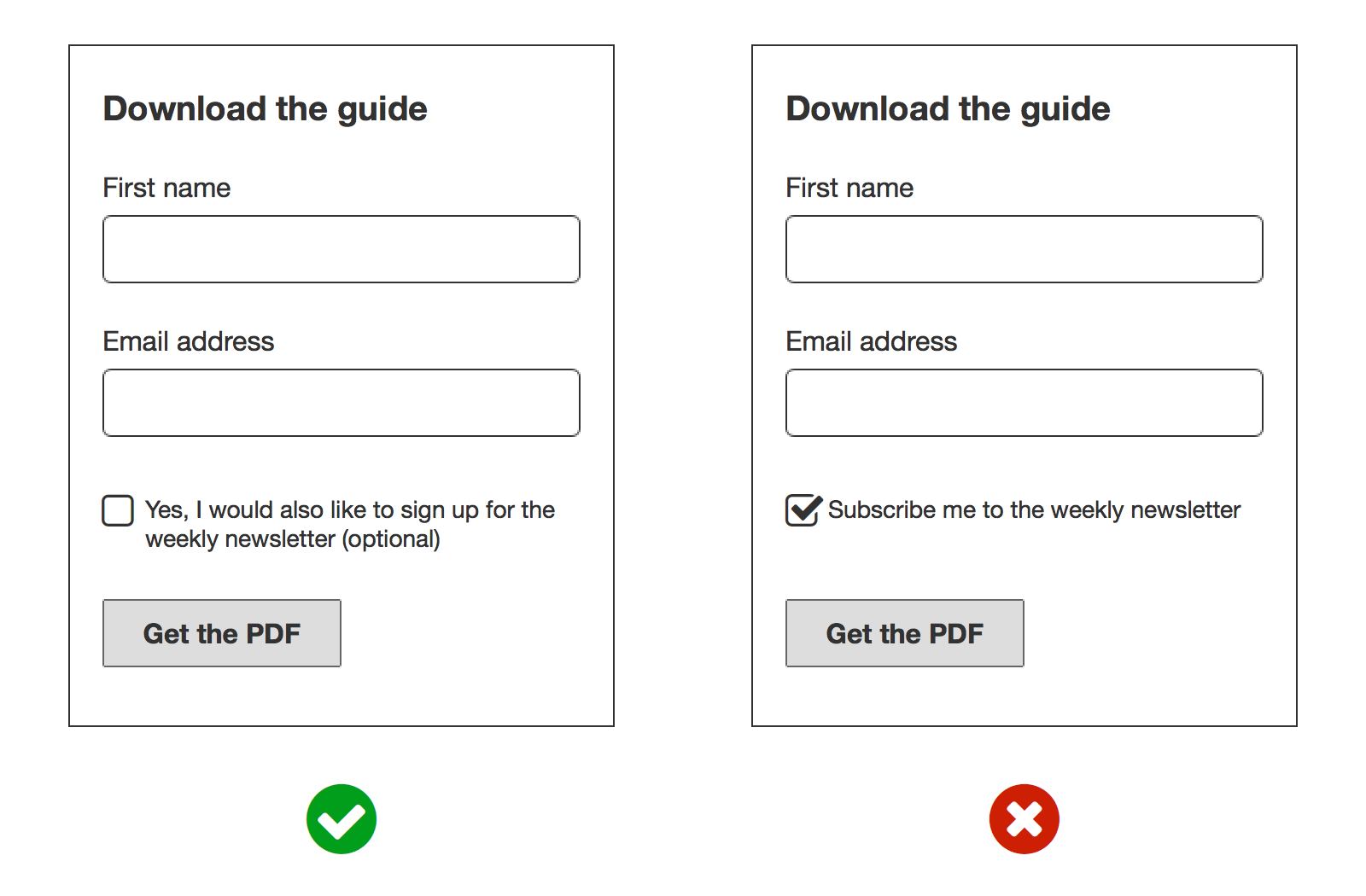
Clean. Granular. Honest. Every checkbox reflects an actual decision the subscriber can make, and the “unsubscribe from all” option is right there.
Step 5: Review data retention and clean your list
Here’s the part where compliance and deliverability really start to overlap.
GDPR says you can’t keep personal data forever “just in case.” You need a retention policy with defined timelines, and you need to actually enforce it. For email marketing, that usually means:
- Active subscribers: Keep them as long as they’re engaged.
- Inactive subscribers (no opens or clicks for 6–12 months): Try a re-engagement campaign. If they don’t respond, suppress them.
- Suppressed/unsubscribed contacts: Keep a minimal record (just the email, hashed if possible) on a suppression list so you don’t accidentally re-add them later. Delete everything else.
- Bounced addresses: Hard bounces must be removed immediately, and also soft bounces, after a defined retry window.
It’s important to remember that ISPs watch your engagement rates.
A list full of people who haven’t opened an email in two years is a list that signals to Gmail that your sends are unwanted (which is how you end up in the promotions tab on a good day, and the spam folder on a bad one). The same list cleanup that keeps you GDPR-compliant is the one that keeps you out of the spam folder.
Set a calendar reminder. Quarterly is reasonable. Audit your list. Re-engage the wobbly ones. Suppress the dead ones. Your open rates will go up. Your costs will go down. Your compliance posture will be in better shape than 90% of your competitors’.
What Happens If You Don’t Comply?
The fine number you’ve probably heard – up to €20 million, or 4% of global annual turnover, whichever is higher – is real. It’s also the headline-grabbing worst case, and it gets reserved for the most serious violations: unlawful data processing at scale, ignoring data subject rights, repeat offenders.
But the smaller stuff adds up too. Tier-one violations, such as bad consent records, no documented lawful basis, sloppy retention, top out at €10 million or 2% of global turnover. Plenty of mid-market companies have been hit for six and seven figures over what looked like minor process failures.
The fines are the visible cost. The invisible ones are usually worse:
- Deliverability damage. Spam complaints from subscribers who never genuinely opted in poison your sender reputation. Once Gmail and Outlook decide you’re a spammer, dragging that reputation back takes months, and often only a fresh sending domain will help you.
- Blacklisting. Major blocklists (Spamhaus, SURBL) act fast on consent-based complaints. Getting listed is quick. Getting delisted is not.
- Customer trust. A breach notification email is the worst marketing email you’ll ever send. People remember it.
- Sales friction. Increasingly, EU enterprise buyers ask about your privacy posture during procurement. If your answer is “we’re working on it,” your deal cycle just got longer.
The companies that treat GDPR as a cost center are the ones it costs the most.
Build a GDPR-Compliant Email Strategy That Also Converts
Look, I’ll level with you. I’ve spent ten years in SaaS marketing, and the moments where I’ve had to choose between “the privacy-respecting thing” and “the growth thing” are vanishingly rare. Almost every time it looks like a trade-off, it’s because someone’s optimizing the wrong metric.
A list of 200,000 people who never asked to be there is a liability dressed up as an asset. A list of 20,000 people who actually want to hear from you is a business. The compliance work, the consent flows, the audit trails, the preference centers, the quarterly cleanups, is what gets you from the first kind of list to the second.
GDPR didn’t ruin email marketing. It just forced us to do the version of it that was always going to work better anyway.
If you’re looking for an email infrastructure that’s built with compliance in mind from day one, Mailtrap’s Email API handles the technical requirements automatically, from TLS encryption, DKIM/SPF/DMARC authentication, ISO 27001 certification, to a signed DPA ready when you need it. Focus on building great campaigns; let the infrastructure handle compliance.
Now go fix your signup form.